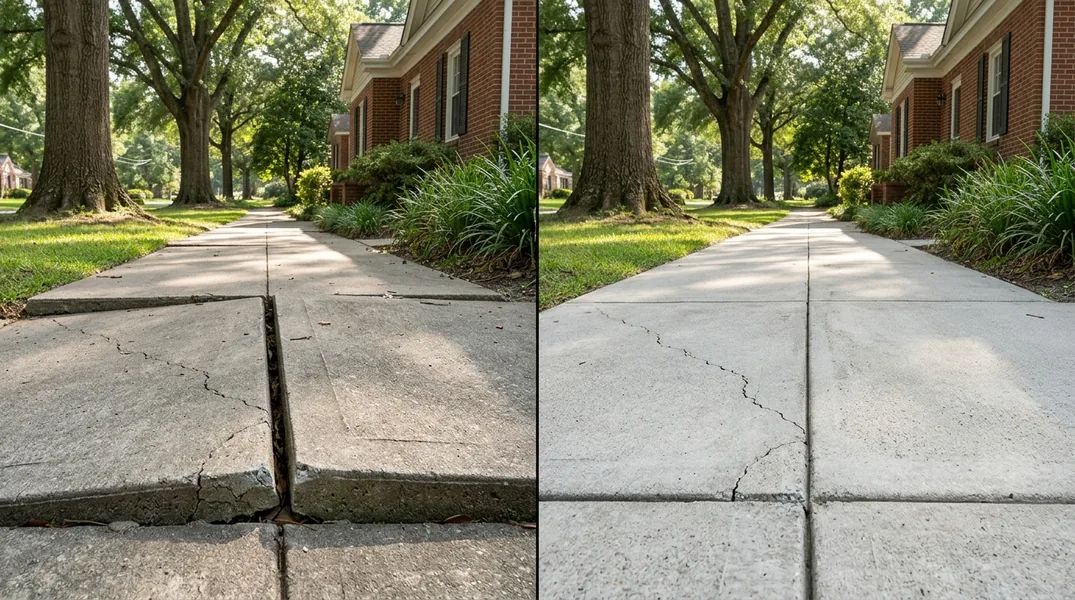
Understanding Columbia's Unique Soil Composition
Columbia sits on the Fall Line, a geological boundary that divides the Piedmont region from the Atlantic Coastal Plain. This location gives the area a distinctive soil profile that most homeowners never think about until their concrete starts showing problems. The dominant soil types in and around Columbia are red clay from the Piedmont and sandhills sand from the coastal plain transition zone. These soils behave very differently from the neutral, stable earth found in other parts of South Carolina and the nation.
Red clay is highly expansive, meaning it absorbs water and swells, then dries out and shrinks dramatically. Sandhills sand, by contrast, is loose and poorly compacted, offering minimal support for heavy structures. When a concrete contractor doesn't account for these soil characteristics during installation, the foundation shifts and settles unevenly. This differential settlement is the primary culprit behind red clay concrete cracking in Columbia, and it's far more common here than in areas with more stable soil types.
Red Clay Concrete Cracking: Why It Happens in Columbia
Red clay is a homeowner's silent enemy when it comes to concrete durability. During wet seasons, clay absorbs moisture and expands, pushing upward on your driveway or patio with tremendous force. During dry spells, the same clay shrinks and leaves voids beneath the surface. This constant expansion and contraction cycle creates stress that concrete simply cannot withstand indefinitely. Over months and years, hairline cracks develop, widen, and eventually become structural problems that compromise the integrity of your investment.
The problem is compounded when contractors fail to properly prepare the subgrade before pouring concrete. If the clay isn't adequately compacted, or if drainage isn't properly managed, water accumulates beneath the slab. This moisture accelerates the clay's movement and accelerates cracking. Many homeowners in Columbia notice their driveways developing a spider web pattern of cracks within three to five years of installation, not because the concrete itself is defective, but because the ground beneath it is moving. This is precisely why choosing an experienced local contractor who understands Fall Line soil slab settlement is critical to your project's long-term success.
Sandhills Soil and Settlement Issues
The sandhills sand found in parts of the Columbia area presents a different but equally serious challenge. This sandy soil has poor bearing capacity, meaning it compresses under weight more readily than clay or well-graded soils. When you pour a concrete driveway over inadequately compacted sandhills sand, the slab gradually settles unevenly. One section may drop lower than an adjacent section, creating a trip hazard and allowing water to pool in low spots. This pooling water then infiltrates beneath the concrete, leading to further deterioration and cracking.
Proper compaction of sandhills sand requires specialized equipment and expertise. A contractor must compact the sand in thin lifts, typically two to four inches at a time, using a plate compactor or similar machinery. Skipping this step or rushing through it is a false economy that leads to costly repairs down the road. The best Concrete Driveways installations in areas with sandhills soil include a well-compacted base layer, often combined with geotextile fabric to stabilize the sand further and prevent it from migrating.
Fall Line Soil Slab Settlement: The Long-Term Problem
The Fall Line runs through Columbia and creates a zone where two very different soil types meet and sometimes mix. In this transition zone, soil consistency can vary dramatically from one property to the next, even across a single lot. This variability means that different parts of your concrete slab may settle at different rates. A corner of your driveway might drop half an inch while the center remains stable, or the back edge might heave upward while the front stays level. This differential settlement is what engineers call slab settlement, and it's the primary reason concrete in this region requires more careful design and installation than in other areas.
Long-term settlement issues are often invisible at first. Your driveway might look perfectly fine for two or three years, then suddenly you notice a step where two slabs meet, or a depression near the edge. These signs indicate that settlement is occurring beneath the surface. Once settlement has begun, it's difficult and expensive to reverse. This is why preventive measures during the initial installation are so important. Proper grading to ensure water runs away from the foundation, adequate base preparation, and the use of reinforcement (rebar or wire mesh) all help minimize settlement risk and extend the lifespan of your concrete.
Preventing Concrete Problems: What Proper Installation Looks Like
The best defense against red clay concrete cracking and sandhills soil settlement is hiring a contractor who understands these local soil conditions and builds them into every project plan. Proper installation begins with a thorough site evaluation. Before a single shovel of concrete is poured, the contractor should assess the soil type, measure drainage patterns, and identify any existing moisture issues. In areas with red clay, this evaluation should include recommendations for moisture barriers or vapor retarders beneath the slab. In sandhills areas, it should specify compaction standards and base layer thickness.
Drainage is perhaps the single most important factor in preventing long-term concrete failure in Columbia. Water is the enemy of concrete longevity, especially when that water interacts with expansive clay. A properly installed driveway slopes gently away from the house and property, directing surface water away from the foundation and the concrete slab itself. Subsurface drainage, such as French drains or perimeter drains, may also be recommended for properties with particularly poor natural drainage. These measures cost more upfront but save thousands of dollars in repairs later.
Reinforcement and proper finishing techniques also play important roles. Concrete Repair & Resurfacing work is often necessary when these fundamentals are overlooked, but with proper initial installation, many homeowners can avoid this expense entirely. Air entrainment, which involves adding tiny air bubbles to the concrete mix, helps the material withstand freeze-thaw cycles and resist water infiltration. Proper curing, which means keeping the concrete moist for several days after pouring, allows it to develop maximum strength and durability.
Concrete Repair in Columbia: When Professional Help Is Necessary
Despite the best preventive efforts, some concrete in Columbia will eventually develop cracks or settlement issues. When this happens, professional Concrete Repair & Resurfacing services can restore functionality and appearance. Small cracks can be sealed with specialized concrete caulk or epoxy injections, which prevent water from entering and causing further damage. Larger cracks or structural issues may require more extensive repairs, such as concrete grinding, mudjacking to level settled sections, or in severe cases, partial or complete replacement.
If you're noticing cracks, settling, or other signs of concrete distress in your driveway or patio, don't wait for the problem to worsen. Contact Columbia Concrete at (803) 830-4186 to schedule a free estimate and discuss repair options. A professional assessment can determine whether your concrete issues stem from soil movement, poor drainage, or other factors, and recommend the most cost-effective solution. Early intervention often prevents small problems from becoming major, expensive failures.
Looking for a professional concrete contractor in Columbia? Columbia Concrete responds fast for all your concrete needs.
Get a Free QuoteOur services: Concrete Driveways · Concrete Patios · Stamped & Decorative Concrete